
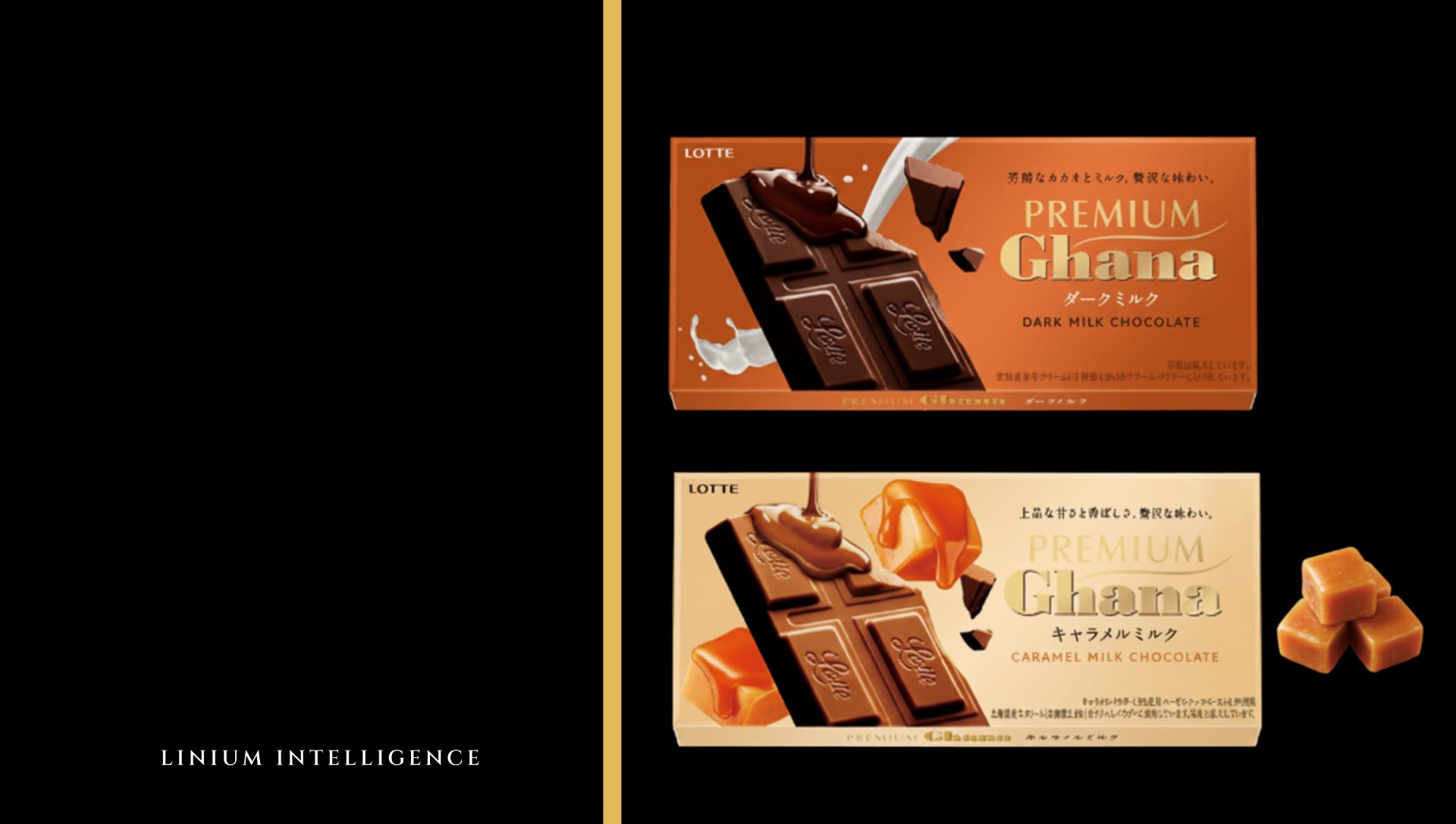
Lotte Japan has announced a significant expansion to its confectionery portfolio with the launch of two new sophisticated variants under its flagship Ghana brand: Premium Ghana Dark Milk and Premium Ghana Caramel Milk. This launch signals a strategic move to capture the growing demand for accessible luxury in the convenience and supermarket channels.
The new Premium Ghana Dark Milk is engineered to bridge the gap between intense cacao profiles and creamy indulgence. It features carefully selected cacao beans blended to offer a mellow aroma, balanced by an elegant milk finish that softens the bitterness often associated with dark chocolate. Conversely, the Premium Ghana Caramel Milk focuses on rich, caramelized sweetness, delivering a fragrant interplay between the deep notes of caramel and the smoothness of milk chocolate. By emphasizing “elegant taste” and “carefully selected” ingredients, Lotte is reinforcing the premiumization of the mass-market chocolate shelf, offering consumers a sophisticated flavor profile previously reserved for specialty chocolatiers.
Premiumization Trends Ongoing In Japanese Chocolate Confectionery
Strategic alcohol pairings and branded collaborations Brands are moving beyond generic “liquor chocolates” to feature specific, high-prestige alcohol brands. Royce’ has released a collection explicitly naming the spirits used, including Hennessy XO cognac, Myers’s Rum from Jamaica, and Port Charlotte Scottish Barley whisky. Similarly, Lindt introduced “The Lady’s Rum Raisin Chocolate Drink,” highlighting the use of Negrita Rum. This transparency appeals to educated consumers who recognize these labels as markers of quality and provenance.
The “Dubai Chocolate” effect (pistachio & kadayif) The global viral trend of “Dubai Chocolate” has firmly landed in Japan, characterized by the use of pistachio cream and crispy kadayif (shredded phyllo dough). Lindt launched both a Dubai Style Chocolate Drink and specific praline/bar formats featuring the pistachio-kadayif combination. & Earl Grey introduced distinct variations of Dubai chocolate, pairing the crunchy kunafa texture with both pistachio and almond bases.
The “haute couture” of mass production: Brands are increasingly adopting the language and techniques of high-end patisserie. Lindt recently unveiled its “Signature Praline” collection, developed over two years by Master Chocolatier Arnaud Ragot to rival boutique offerings. La Maison du Chocolat has revitalized its portfolio with the Batônnet Praliné collection. This launch emphasizes specific textural engineering—such as the use of crêpe dentelle (finely crushed crispy crepes) and caramelized biscuit pieces.
Specific provenance of fruit: Generic fruit flavors are being replaced by region-specific varieties to signal premium quality. Mary Chocolate specifies the use of “Amaou strawberries from Fukuoka” for its Chocolat Tororii series. Cacaoken similarly highlights “Hakata Amaou” strawberries in its white chocolate bars to emphasize the balance of acidity and sweetness unique to that cultivar. Seiste Chocolate utilizes “Kito Yuzu from Tokushima” and lemons from Hiroshima, leveraging domestic terroir as a primary selling point.
Hybrid “dessert” formats Chocolate is increasingly mimicking full desserts rather than standing alone as a confectioner. KitKat rolled out “Apple Pie” and “Strawberry Shortcake” variants that use flavored doughs and creams to replicate baked goods. Royce’ introduced a “Choco-Banana” Nama Chocolate inspired by Japanese festival stalls, and a Florentine Sandwich that layers caramel-coated nuts between cookies. Lindt introduced Lindor truffles in “Cookies & Cream”, and “Tiramisu” and as well as a “Neapolitan” flavor inspired by the tri-color ice cream.